



General Bee Information
Bees can be found almost everywhere in our environment. They play a crucial role in the ecosystem and in the agricultural industry. There are thousands of bee species in North America; about 1500 of them are found in California.
The best-known bee is the European honeybee (Apis melifera) because of its strong relationship to man. Long ago, humans discovered ways to manage honeybees in order to use their products and utilize their pollination capability. Bee products such as honey have become important household commodities, not only for their nutritional value, but also for medicinal purposes. According to the U.S Food and Drug Administration, one-third of the food eaten by Americans are from crops pollinated by honeybees.
The honeybee is not native to North America. It was brought here during the discovery of the New World and followed man to California in the 1800s. Humans have been drawn to this insect because of its ability to adapt to domestication, their complexity, pollination capability, and the wonderfully useful products they make. Despite the sometimes painful encounters we have with bees, the complexity of this organism and the products they make still draw us to love and admire this remarkable creature.
Threats to Bees
In 2006, a mysterious die off of honeybees called Colony Collapse Disorder (CCD) caused heightened awareness of pollinator health nationwide. The cause of CCD is still unknown but may be a combination of stressors from pathogens, parasites, pesticides, bee management practices, environmental conditions, and immune-suppression.
In May 2015, the National Strategy to Promote Pollinator Health was developed in response to the decline in honeybees. Despite a bee’s occasional nuisance, public awareness of pollinator decline has generated an interest in bees and an increase in urban beekeeping.
Homeowners can help preserve bees by providing safe spaces for bees, and other pollinators, and by limiting the usage of chemical pesticides applied in the garden and flowering plants. If pesticides are needed, homeowners are encouraged to make applications during evening hours when bees are not foraging.
Beekeepers can do their part in protecting bee populations by implementing integrated pest management practices, which prevent the spread of pests and diseases.

Deceased Bee
Bee Encounter – What to do
- As a general rule, stay away from all bee swarms and colonies.
- If bees are encountered, leave the area as calmly and quickly as possible.
- While leaving the area, try to protect your face and eyes.
- Take shelter in a car or building. Water or thick brush does not offer enough protection.
- Do not swat at bees: rapid motions will cause them to attack.
What To Do If Stung (First Aid)
- Go quickly to a safe area.
- Remove the stinger as soon as possible.
- Don’t squeeze the stinger; pressure will release more venom.
- Scrape the stinger out with your fingernail, knife blade, or credit card.
- Wash the sting area with soap and water like any other wound.
- Apply an ice pack for a few minutes to relieve pain and swelling.
- Seek medical attention (call 911):
- If breathing is troubled,
- If stung numerous times, or
- If allergic to bee stings.

Scrape the stinger out with a card
Bee-Proofing Your Home
Africanized and European Honeybees both like to establish colonies in hollow areas. Bee proofing to prevent bees from entering a wall void or attic can be done by sealing, caulking, patching or screening any opening larger than 1/8th of an inch. Locate places around your home that bees might want to use as nesting sites and correct them before the bees find them. Possible locations include, but are not limited, to:
- Air vents
- Pipe holes
- Roof junctions
- Gaps under eaves
- Cable wiring holes
- Missing light fixtures
- Chimney roof junctions
- Openings in exterior walls
- Electric meter compartments
- Gaps between roofing and fascia boards
- Debris/Trash items/Empty containers-boxes, buckets, pots, lumber piles, old furniture
Major repairs to your home may require obtaining permits and coordinating with building inspectors. If there are any questions about this, call your local Building and Safety Office. For minor repairs, the tools and materials shown here are available at any local hardware or home improvement store.

Feral beehive attached to a house
See below for examples of home repairs to bee proof your home

Caulk gaps and cracks larger than 1/8”
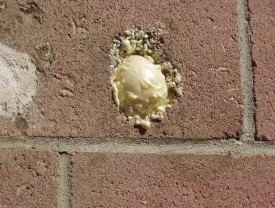
Use stucco or plastic patching material to seal holes in walls
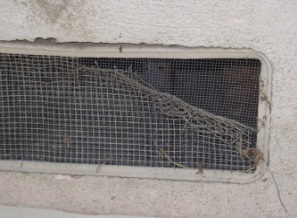
Seal vents with 1/8” mesh screens

Fix narrow gaps using insulating foam
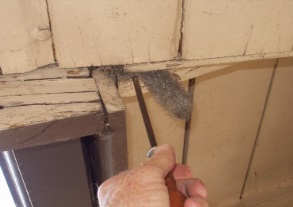
Fill wide gaps with steel wool or 1/8” mesh hardware